
TWSE and SparkLabs Taiwan Host Industry Gathering to Connect Physical AI Innovators with Capital Markets
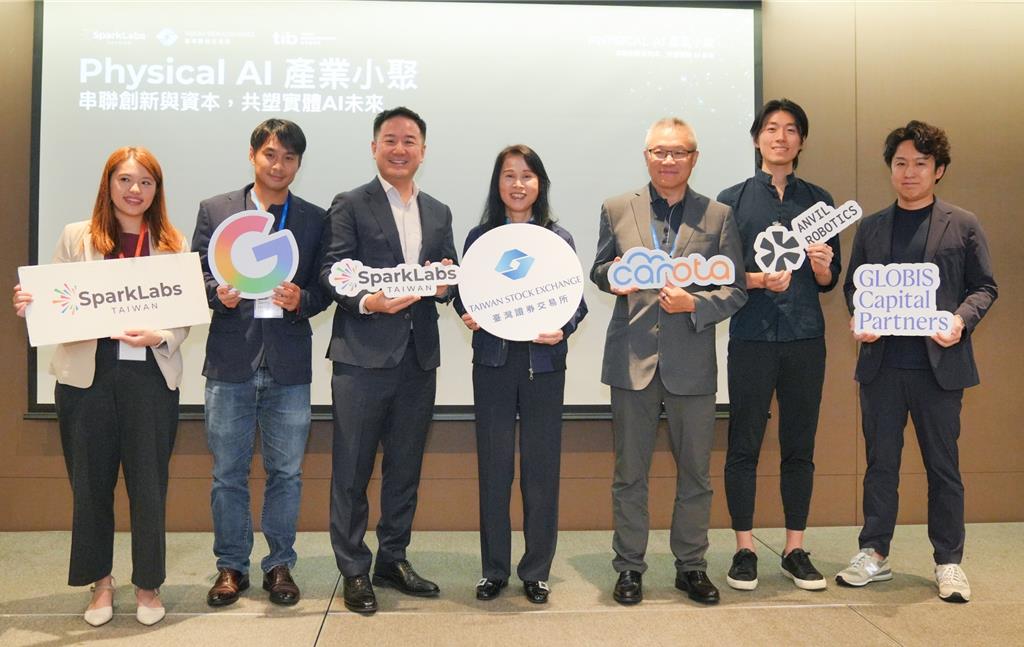
From left: Meng-Yao Chien, Director of SparkLabs Taiwan; Jerry Hsiung, Head of the
Semiconductor Industry for Asia Pacific at Google; David Chiu, Managing Partner of
SparkLabs Taiwan; Alice Lee, President of the Taiwan Stock Exchange (TWSE);
Paul Wu, Founder and CEO of Carota; Mike Xia, Co-founder and CEO of Anvil Robotics;
and Ryohei Nomoto, Director of GLOBIS Capital Partners, attended the event together.
The Taiwan Stock Exchange (TWSE), in support of the government's strategic initiative to foster innovative industries, partnered with international venture capital firm and startup accelerator SparkLabs Taiwan to host the "Physical AI Industry Gathering: Connecting Innovation and Capital to Shape the Future of Physical AI" on June 25.
The event brought together leading representatives from the Physical AI manufacturing supply chain, global technology companies, multinational venture capital accelerators, and other key industry stakeholders.
Focusing on emerging technologies such as intelligent robotics, autonomous systems, and physical devices equipped with perception and decision-making capabilities, the event aimed to connect Taiwan's most promising Physical AI startups with the capital market. Through this initiative, TWSE seeks to strengthen the next generation of advanced industrial ecosystems and further its vision of positioning Taiwan as the "Nasdaq of Asia."
During her opening remarks, TWSE President Alice Lee noted that Taiwan's capital market continues to demonstrate remarkable momentum, with average daily trading value rising from over NT$400 billion last year to more than NT$1 trillion today.
Looking ahead, she emphasized that the next major wave of AI transformation lies in the adoption of Physical AI across factories, transportation, healthcare, and other real-world industries. The critical challenge, she said, is how to successfully scale innovations from laboratory research into large-scale commercial deployment.
Lee further stressed that startups need more than capital to overcome this growth barrier—they also require a capital market that recognizes and understands the value of innovation. Taiwan's decades of expertise in semiconductors, precision manufacturing, and system integration provide a unique advantage by enabling industry-driven capital formation.
She added that through the Taiwan Innovation Board (TIB), the capital market can serve as a powerful catalyst for emerging industries expanding globally. It can help Physical AI companies transform technological advantages into scalable business models while enabling investors to participate early in the next wave of industrial growth.
The event focused on real-world applications and growth pathways for Physical AI across different stages of the value chain.
In a keynote session, Mike Xia, Co-founder and CEO of Anvil Robotics, a Silicon Valley-founded Physical AI startup with operations in Taiwan, shared insights into the current challenges facing the large-scale deployment of Physical AI and offered recommendations for overcoming these barriers.
Meanwhile, Paul Wu, CEO of Carota, discussed how OTA (Over-the-Air) updates, device management, and software platforms are becoming critical infrastructure in the Physical AI era. He also highlighted how Taiwan's software companies can seize opportunities created by the next wave of industrial transformation.
One of the event's highlights was a panel discussion jointly organized by SparkLabs Taiwan, bringing together global technology leaders, leading Japanese venture capital firms, and Taiwan-based Physical AI startups to explore how Physical AI can progress from technology validation to large-scale commercialization.
The panel featured Jerry Hsiung, Head of Semiconductor Industry for Asia Pacific at Google, who analyzed global Physical AI trends from an international industry perspective and emphasized Taiwan's strategic role within the global supply chain.
Also joining the discussion was Ryohei Nomoto, Investment Director at GLOBIS Capital Partners, one of Japan's leading venture capital firms. He shared insights into emerging global investment trends in Physical AI and the development of its international innovation ecosystem.
David Chiu, Founder and Managing Partner of SparkLabs Taiwan, stated that one of the biggest challenges facing Physical AI startups is coordinating complex hardware supply chains while accelerating mass production. He noted that Taiwan's unique ecosystem, which integrates both hardware and software capabilities, has become a strategic cornerstone for startups seeking to commercialize their technologies globally.
Chiu further emphasized that support from the Taiwan Innovation Board and Taiwan's capital market can significantly accelerate the journey of Physical AI companies from technology validation to international expansion. SparkLabs Taiwan will continue collaborating with the Taiwan Stock Exchange to connect global resources, capital markets, and the startup ecosystem, helping Taiwan's innovative enterprises expand onto the world stage.